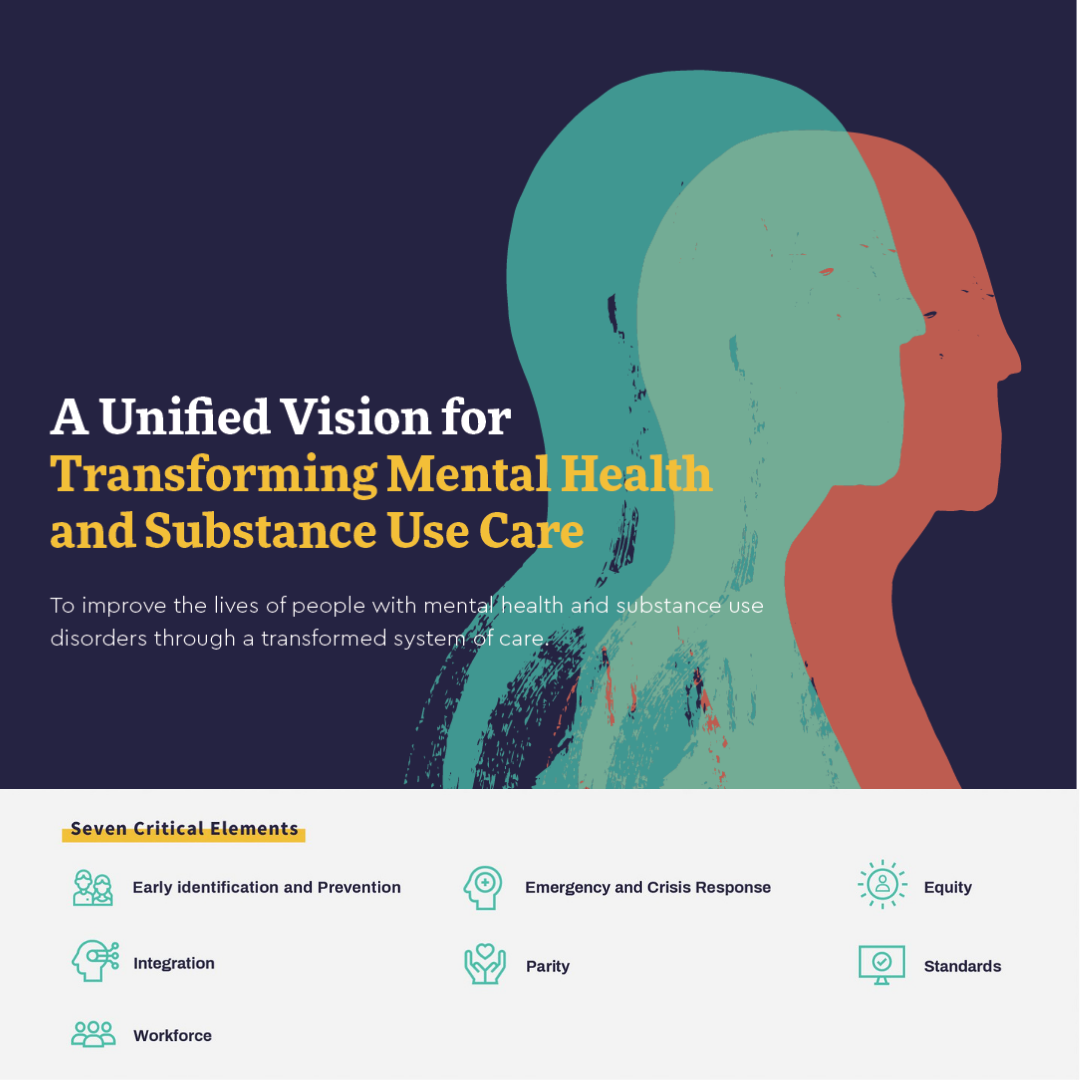
 The National Association of Social Workers (NASW) has joined a collaboration of more than 30 mental organizations that have signed onto a Unified Vision, a seven-pillar roadmap developed to address the future of mental health and substance use care in America.
“As the nation’s largest provider of mental and behavioral health services, social workers recognize that promoting improved mental health and well-being for all people, especially for Black, Brown and Indigenous people, requires transformative systemic and structural changes,” said NASW CEO Angelo McClain, PhD, LICSW. “We welcome the opportunity to collaborate in new ways to realize the aspirations outlined in the Unified Vision.”
Founded in March 2020 at the onset of the COVID-19 pandemic, the collaboration is the only group of its kind that includes collaboration by the chief executives of the nation’s premier mental health and substance use care organizations, all working in unprecedented unity to advance core issues in the United States.
In December, the collaboration released its Unified Vision, a key series of action items intended to prompt and establish policy, programs and standards that prioritize mental health care and address the social and economic conditions – including racism and discrimination – that disproportionately impact people of color and people whose incomes are below the federal poverty threshold, and result in inadequate and inequitable access to effective, humane treatment.
Founding members of the collaboration and creators of the Unified Vision are the American Psychiatric Association, the American Psychological Association, the Massachusetts Association for Mental Health, Meadows Mental Health Policy Institute, Mental Health America, the National Association for Behavioral Healthcare, the National Alliance on Mental Illness, the National Council for Behavioral Health, One Mind, Peg’s Foundation, the Steinberg Institute, The Kennedy Forum, the Treatment Advocacy Center and Well Being Trust.
Besides NASW, other organizations that have recently signed on include the American Counseling Association, the Clinical Social Work Association and the American Group Psychotherapy Association.
“An early priority is to break down the silos that currently exist in the mental health and substance use care space, which are all too often barriers to systemic change,” said Daniel H. Gillison, Jr., from NAMI. “Our leadership team and recent signatories collectively represent close to 40 independent organizations, willing to work together on one of the direst issues of our time. We thank our signatories for their crucial support, and we look forward to even more progress in the weeks and months ahead.”