
By Diana Ling, MA, Senior Program Manager; and Anna Mangum, MSW, MPH, Senior Health Strategist; Health Behavior Research and Training Institute (HBRT); The University of Texas at Austin School of Social Work
April is Alcohol Awareness Month, an opportunity for social workers to get the facts on alcohol’s health effects. As the nation’s largest mental and behavioral health workforce, providing services in a wide range of practice settings, social workers are essential resources for evidence-based information about client alcohol use.
Here are three key facts to share with clients in conversations about their drinking:
The less you drink, the better it is for your health.
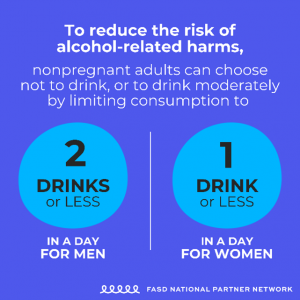
According to the Centers for Disease Control and Prevention (CDC), moderate drinking is:
- one drink or less in a day for women who aren’t pregnant, and
- two drinks or less a day for men.
Women face unique risks from alcohol, including alcohol-exposed pregnancy.
 Alcohol guidelines differ for men and women because after drinking the same amount, women tend to have higher blood alcohol levels, and the immediate effects of alcohol usually happen faster and last longer in women than in men.
In addition, compared to men, women who drink have a higher risk of developing alcohol-related liver diseases, heart damage, and a faster decrease in mental functioning.
In women of reproductive age, drinking increases the risk of alcohol-exposed pregnancy (AEP), a leading preventable cause of fetal alcohol spectrum disorders (FASDs), a group of diagnosable medical conditions with lifelong effects. People with FASDs can have problems with mental health, learning, and behavior, as well as physical issues such as heart defects and visual impairments.
It’s important to share with clients that there is no known safe amount of alcohol to consume, no safe time to drink, and no safe type of alcohol to consume during pregnancy. All types of alcohol can be harmful to a developing baby, including wine, beer, and liquor.
Alcohol screening, brief intervention, and referral to treatment (SBIRT) is a highly effective, evidence-based approach to identifying and addressing risky alcohol use.
SBIRT is a comprehensive, research-backed approach to early intervention for substance use disorders that is used in healthcare and other practice settings nationwide. The U.S. Preventive Services Task Force recommends alcohol SBI for all adults, including pregnant women. Using a validated screening tool can take as little as one minute, followed by a brief conversation with those who are drinking too much, and referral to treatment if appropriate.
Learn More
Practice Perspectives: Screening, Brief Intervention, and Referral to Treatment (SBIRT) for Risky Alcohol and Other Substance Use (NASW)
Video Series: Lived Experiences with Fetal Alcohol Spectrum Disorders (CDC)
Alcohol and Pregnancy (CDC)
Drink Size Badge Card (HBRT in partnership with NASW Foundation, Oak Ridge Associated Universities and CDC)
SBIRT Pocket Card (HBRT in partnership with NASW Foundation, Oak Ridge Associated Universities and CDC)
The Healthcare Professional’s Core Resource on Alcohol (NIAAA, CEs available)
FASD National Partner Network: Ready-to-Use Materials
Alcohol and Cancer Risk: The U.S. Surgeon General’s Advisory
This initiative, Engaging Social Workers in Preventing Alcohol- and Other Substance-Exposed Pregnancies, is supported by the Centers for Disease Control and Prevention of the U.S. Department of Health and Human Services as part of a financial assistance award totaling $1,222,292 with 100 percent funded by CDC/HHS. The contents are those of the authors and do not necessarily represent the official views of, nor an endorsement by, CDC/HHS, or the U.S. Government.