 As advocacy efforts have grown, both for and against the use of sexual orientation change efforts (SOCE) and conversion therapy, so has the need to educate clients and communities about the impact of these practices on individuals and families, and the implications for social work practice.
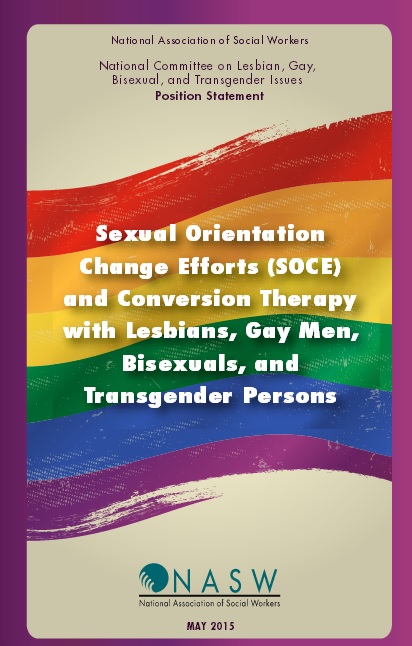
To help guide practice, the National Association of Social Workers (NASW) has issued a Position Statement entitled, Sexual Orientation Change Efforts (SOCE) and Conversion Therapy with Lesbians, Gay Men, Bisexuals, and Transgender Persons. The updated Position Statement was adopted by the NASW Board of Directors in May, and is now available on the NASW website.
The Position Statement also highlights policy positions included in Social Work Speaks (10th Edition), including:
- NASW reaffirms its stance against reparative therapy and other sexual orientation change efforts (SOCE) designed to change sexual orientation or to refer clients to practitioners or programs that claim to do so.
- NASW condemns the use of SOCE or so-called Reparative Therapies by any person identifying as a social worker or any agency that identifies as providing social work services. Public dollars should not be utilized for programs that support SOCE.
Posted by Evelyn P. Tomaszewski, MSW