
By Morgan Lloyd, LCSW
For many people, mental health care is out of reach. Cost, long wait times and a shortage of available providers are a few reasons why. Some have turned to AI instead.
But social workers have been careful not to confuse support with clinical treatment. After all, a coping suggestion is not a clinical assessment. A response that sounds caring is not the same as a therapeutic relationship with another person. A chatbot is not accountable to a licensing board, a code of ethics, a supervisor, or a duty to protect.
These concerns are not abstract. In one simulated exchange reported by The Washington Post, an AI chatbot suggested that a fictional user in recovery from methamphetamine addiction take “a small hit” to stay awake for work. In another widely reported case, the National Eating Disorders Association suspended its Tessa chatbot after reports that it gave users weight-loss and calorie-counting advice in the context of eating-disorder support.
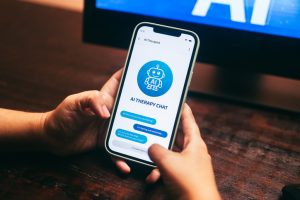
AI therapy chat app on smartphone.
Many U.S. social workers are already using artificial intelligence in their professional practice, and most say they need clearer ethical guidelines, stronger client protections, and more training to do it responsibly, according to a recent national survey of social workers conducted in collaboration with NASW by the Moritz Center for Societal Impact at The University of Texas at Austin School of Social Work. The survey was released during the NASW conference in June.
For these reasons, NASW has raised concerns about the use of AI in mental health care and many of its chapters have been instrumental in getting state law to weigh in on its usage. Kyle Hillman, director of legislative affairs for NASW’s Illinois Chapter, put the distinction clearly: “Artificial intelligence is a tool, not a therapist.”
The survey revealed that social workers are already navigating this distinction in their everyday work.
“Many social workers are using AI to alleviate administrative demands, speed up documentation processes, and support routine professional tasks,” said Dr. Elisa Borah, director of the Moritz Center for Societal Impact. “Practitioners are asking for leadership: clear ethical standards, stronger client protections, and training that keeps pace with the tools they’re already using. This survey also shows real concern about where the line is, who sets it, and what happens when technology enters spaces that require human discernment, accountability, and care.”
Nearly two-thirds of social workers reported using AI in their current roles, most often for routine tasks such as correspondence, reports, and documentation, according to the study.
But respondents also described AI entering more sensitive areas, including clinical documentation and client-intervention tools, raising concerns about confidentiality, informed consent, data protection, professional judgment, and the limits of automation in a field built on human relationships.
The study showed that respondents identified clear ethical guidance, stronger client protections, and additional training as the profession’s most pressing needs related to AI. In response to the need for greater clarity, NASW’s Code of Ethics Revision Workgroup is recommending supplemental guidance to help social workers apply the Code of Ethics to the use of artificial intelligence. The findings reveal a profession asking for leadership and safeguards as adoption moves faster than governance.
State legislatures are also beginning to respond. Championed by the NASW Illinois Chapter, that state recently passed the Wellness and Oversight for Psychological Resources Act, which creates legal guardrails around the use of AI in mental health services. Nevada and Utah have taken similar steps. The NASW Nevada Chapter also championed laws surrounding the use of AI. Nevada has restricted AI systems from being used or marketed as a substitute for mental or behavioral health care, while Utah has created disclosure and privacy requirements for mental health chatbots.
As these tools become more widely available, the ethical question is not simply whether AI can be useful in a strained system of care. It is how AI can be used responsibly, with clear recognition of its limits. AI may offer supplemental support, but it cannot provide the judgment, accountability, and relational understanding required in moments of vulnerability and emotional need.
For clinical social workers, that distinction matters, and this is exactly why NASW and state legislatures are paying attention.
The full report, “Use of Artificial Intelligence in Social Work Practice: Findings and Recommendations from a National Survey,” is available from the Moritz Center for Societal Impact.
NASW Member Morgan Lloyd, LCSW, is a therapist in Walnut Creek, Calif. She can be reached at https://www.morganlloyd-lcsw.com